


September cash rate: how do increases impact your repayments?
As was broadly predicted, the cash rate today increased to 4.6%. This is the first increase since May and is the highest the cash rate has been since 2011. Much has changed compared to 15 years ago, so things this time will look a little different.
Comparing repayments today to 2011
While we have seen interest rates at this level before, a key difference is property prices. In 2011 the average house price was $486,900. Today, the average is $912,885. What does that look like in repayments? Say the interest rate is 6.25% p.a., with a loan term of 25 years paying principal and interest. A loan of $389,520 for our average home in 2011 would cost about $2,569 a month. A loan of $730,308 for our average home in 2026 would cost about $4,818 a month.
The average annual full-time income in 2011 was $69,336.80. Today this is around $108,378. In 2011, that was an average of 44.4% of one person’s income going to mortgage repayments. In 2026, that is 53.3% of one person’s income.
We can see the maths is not in favour of today’s average homeowner.
What does one or two cash rate increases mean for your repayments?
The changes to your home loan repayments depend on a number of factors. Any increases to interest rates will only impact people on a variable rate. If you have a split loan, it only changes on the variable-rate split. The change in your repayments depends on how large your loan is. We can have a look at an example.
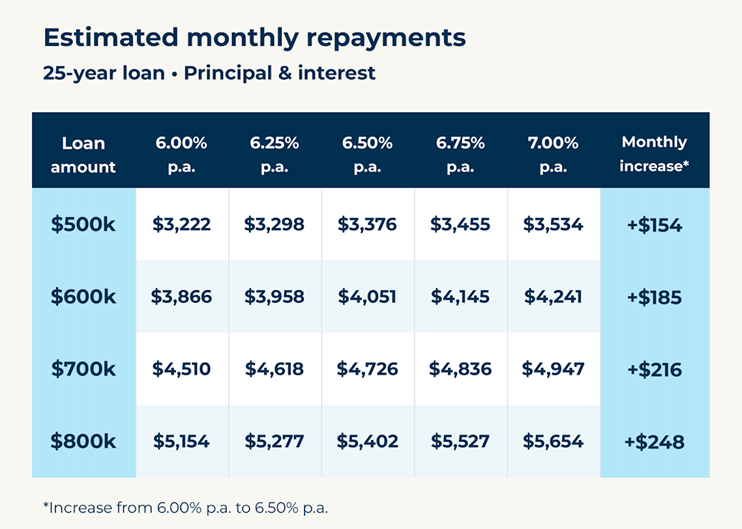
A loan of $500,000 on a 25-year term paying principal and interest and a rate of 6.0% p.a. may see monthly repayments change from $3,222 to $3,298 - an increase of $76. If there are two cash rate increases, it could increase their interest rate to 6.5% p.a., which would see their monthly repayments increase by a total of about $154.
The table below shows how much repayments could increase by. The monthly increase calculation is showing if there are two cash rate increases for someone currently on a 6.0% p.a. interest rate and two .25 percentage point increases.
What can you do if your repayments go up?
It is a good idea to have a plan for interest rates increasing. Start with a conversation with your broker. They can see if you are still on a competitive deal or if you could benefit from any changes to the structure of your loan. If you are feeling in a bind with your repayments due to a change in your circumstance, you may be able to extend the term or potentially switch to interest only. Keep in mind these strategies usually result in paying more over the life of the loan.
Making additional payments into an offset account or into your home loan could reduce the total amount of interest you pay. You may re-evaluate your strategy, such as contributing more money into your offset instead of a savings account if the interest rate is higher in the former.
A chat with your broker is free. Reach out to set up a conversation to understand your options.